
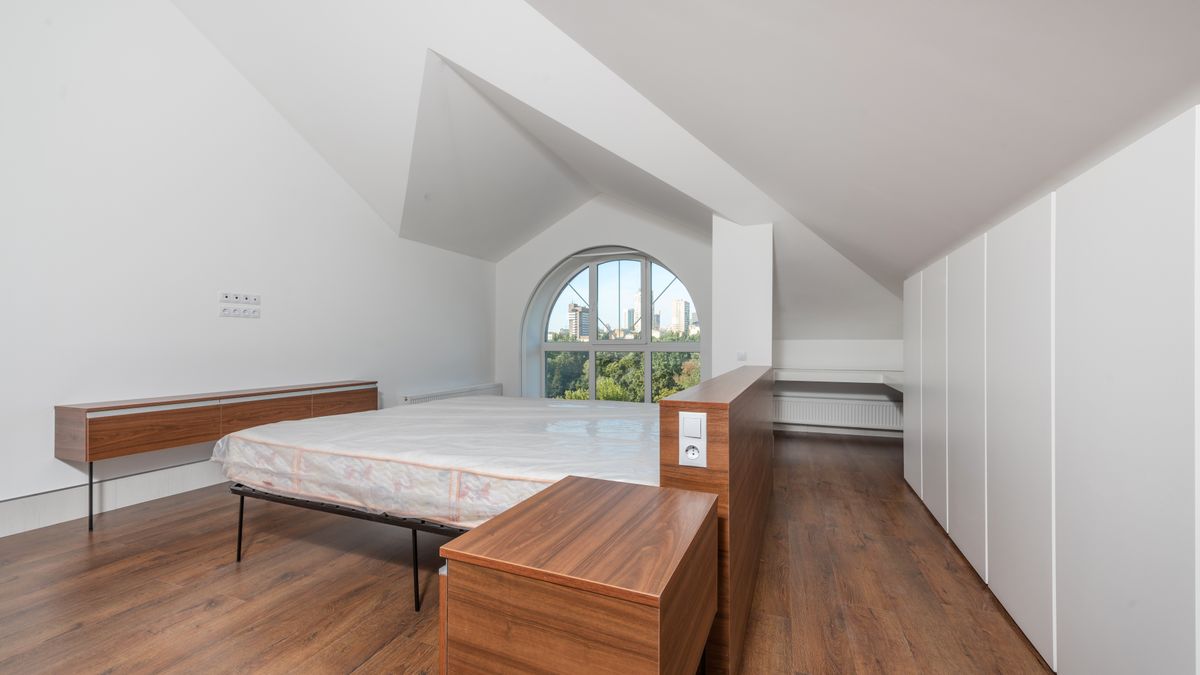
Before you think about roof windows, en-suites or bespoke wardrobes, you need to answer one question: is there enough head height? For most habitable loft conversions in the UK, you need a clear height of at least 2.2 metres. Measure from the highest point of the existing floor to the underside of the roof ridge. If that number is below 2.2 metres, a bedroom, bathroom or home office may not be possible without significant structural work. If it is comfortably above, you have options. This measurement is the single most important constraint on your project.
You can get a good initial reading with a tape measure, a straight edge and a spirit level, or a laser measure. Work safely: boards across the joists, a torch, and no solo adventures near the hatch. Measure from the highest point of the floor, because that is where the finished floor will be. Measure to the underside of the ridge board or the apex of the rafters, not to the top of the tiles. Then repeat the measurement every metre or so along the ridge. Old houses rarely have a perfectly level ridge or floor, and a difference of 50 millimetres can change your plans.
For example, if you measure 2.35 metres to the underside of the ridge, subtract 75mm for a plasterboard ceiling and 25mm for flooring. You are left with roughly 2.25 metres. That is workable, but only just. If you plan to insulate between the rafters, you may lose more.
The 2.2 metre figure is a common benchmark, not a magic number that applies to every square centimetre. Building control teams generally want to see around 2.2 metres over a substantial part of the room, often at least half the floor area. The remaining space can be lower, which is why eaves areas work well for wardrobes, drawers, desks or a bed with its head against a low wall. But if only a narrow strip at the very apex reaches 2.2 metres, a bedroom or bathroom is unlikely to pass as habitable. Stairs are another pinch point: you need at least 2 metres of clear headroom on the flight and at the landing. A bathroom needs enough height for a shower and for someone to stand at the basin.
If your ridge height is around 2.1 to 2.2 metres, do not give up immediately. There are ways to gain head height, though each has a cost. A dormer window can create a full-height wall on one side of the roof, often transforming a cramped loft into a usable room. Raising the ridge is possible but usually requires structural design, Building Regulations approval and sometimes planning permission. Removing a collar tie or replacing it with a higher structural beam can open up the centre, but it must be engineered. Slim floor joists and a shallow ceiling build-up can claw back precious centimetres. If the loft is only suitable for storage, a proper conversion may not be viable, and a good designer will tell you that early.
Head height is not just about the centre of the loft. Check the top of the stairs, where a sloping ceiling can catch you out. Look at doorways, the shower, the landing and any area where you will stand upright. Chimney breasts, purlins and roof trusses can interrupt the usable space. If you have a traditional cut roof, you may have more flexibility than with a modern trussed roof, which is often designed as a structural unit and is harder to alter. Water tanks and flues may also need moving. A laser measure and a notebook will help you map the low spots before you design anything.
If your measurements are close to the limit, or if the roof structure is complex, bring in a chartered surveyor, structural engineer or experienced loft designer. They can confirm the true head height, check the structure and advise on Building Regulations. A builder’s enthusiasm is not a substitute for a proper assessment. Spending a few hundred pounds on professional advice now can save thousands later, and it will tell you whether your attic can become the room you want. In most UK homes, head height is the make-or-break factor. Measure it honestly, allow for finishes, and plan from there.

Hi, my name is Anthony kuber. I am artist and fashion designer.
I love to travel and writing blogging.
Your email address will not be published. Required fields are marked *
Software Developer & Writer
Hey, I'm Diva, a developer and writer blending code and creativity. I'm driven by a deep curiosity and a relentless pursuit of excellence. Join me as I craft digital solutions and captivating stories.


